 |
The HuT
Building a safe haven to cope with climate extremes
|
| |
|
The latest news from the Human-Tech Nexus Project – Building a safe haven to cope with climate extremes
|
| |
|
Dear reader,
Welcome to the fourth edition of The HuT Newsletter.
As climate extremes continue to challenge communities across Europe and beyond, understanding how people, technology, and institutions can work together to build resilience has never been more important. In this issue, we explore lessons from the devastating Blatten rockslide in Switzerland, examine how a warming climate is reshaping coastal experiences and safety in Dorset, UK, and highlight the launch of the world's first open-access Warning Database developed by University College London.
We also bring you updates from our partner projects, upcoming events, recent publications, and new outputs from The HuT consortium. Together, these stories showcase the importance of collaboration, knowledge exchange, and innovation in strengthening our capacity to prepare for, respond to, and recover from climate-related hazards.
|
| |
|
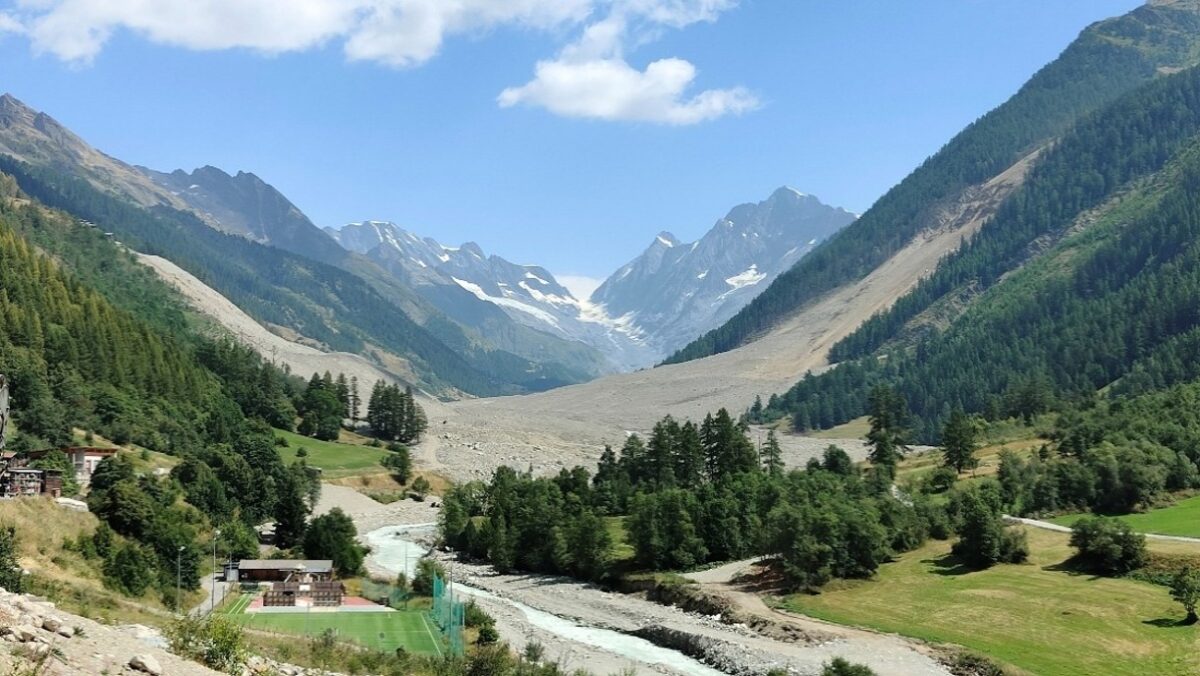
The valley floor near Blatten completely covered in debris after the landslide on May 28, 2025 (photo: Manfred Stähli, WSL) |
| |
Thoughts on the Blatten rockslide
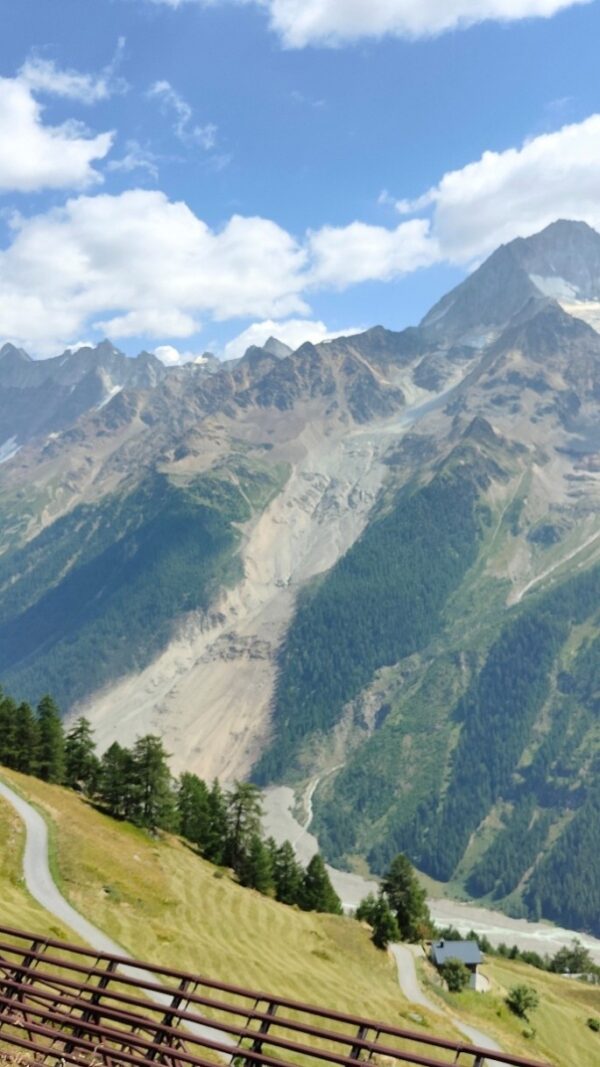
What happened on May 28, 2025, in a Swiss mountain valley (Lötschental, Valais) made headlines around the world: a glacier collapse followed by a massive landslide led to the almost complete burial of the tourist resort of Blatten within a few seconds. Thanks to early detection of the danger and prudent and decisive action by the local authorities, all residents except one fatality were brought to safety in time. The detailed sequence of events and the ongoing assessments by the responsible cantonal geologist have been recorded in an online lecture for the international network on landslide early warning systems - LandAware. The corresponding video is available here.
The Blatten case is an excellent example of a complex multi-hazard event whose management requires a wide range of specialist knowledge and cooperation between rescue services, local authorities, private engineering firms, and researchers. It was only thanks to the committed and thoughtful actions of all these actors and professional communication that it was possible to keep pace with the emerging changes and respond appropriately. In retrospect, it can be said that, despite all the uncertainty and stress, the decisions made were very good and timely overall.
This is precisely what the HuT project is all about. The slogan "Building a safe haven to cope with climate extremes" is a very apt description of the guiding principle of those responsible for the safety of the inhabitants of the Lötschental valley. Protecting the population is the top priority, and to guarantee this, all extreme scenarios had to be thought through in advance. For this to succeed, it required not only many years of expert knowledge and experience, but also an exchange of experience across the various processes and roles. It is precisely this exchange of experience that is at the heart of The HuT project.
A second key success factor for the management in Blatten was the communication of the situation to the residents affected. Providing information quickly, honestly, authentically, and empathetically was key to helping people deal with the stressful situation and ultimately support the decisions made by the authorities. In this regard, it is my hope that the work of The HuT Project will bring us closer to a best practice where we learn from these types of events and pull together knowledge and expertise to ensure future events are managed safely and effectively.
|
| |
|
View of the Blatten-landslide from the opposite slope (photo: Manfred Stähli, WSL) |
| |
|
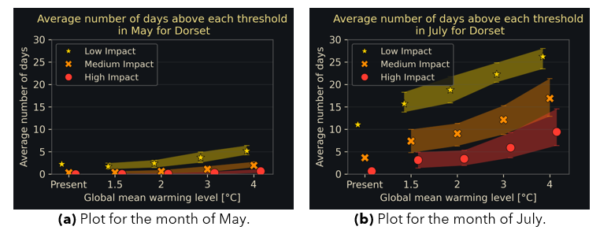
Figure 1: Average number of days for Dorset above low, medium and high impact thresholds for different Global Warning Levels. Thresholds provided by the Met Office Ensemble Prediction System Girst Guess Warnings (EPS-W) as a guide. Based on HadUK-Grid dataset (observations) at 12 km grid size, from January 1981 to December 2000, for “Present” calculations. The future global warming levels are derived from the 12 members of UKCP18 at 12 km scale with a Linear Scaling Bias Correction applied. Closest member to the mean number of days is shown as a dot, with shading covering to second lowest to second highest member |
| |
Beach days from May to October? Melting heat in summer: Dorset, UK
The warm months roll around, and we can hear the beach calling. Whether it’s a quick nip down after work for those who live nearby, or a planned weekend for those travelling further, the coast offers all the fun and magic of the sea.
But what if those warm months started earlier? And if warmth starts earlier, what happens to the hot summer months? Within Demonstrator 9 of The HuT Project, the Met Office and the Royal National Lifeboat Institution (RNLI) have considered what a warmer climate means for heat-related weather warnings throughout the year.
As our climate changes, the beach season is quietly stretching, and the summer days are getting hotter. We are already seeing warmer days arrive earlier in the year and linger later into autumn. For Dorset, this could mean beach weather not just in July and August, but regularly from May through to October. However, the extra heat is to be respected. Today, May usually brings only a couple of days where heat may start to feel uncomfortable. But by the middle of the century, we could start seeing days where heat is high enough that we see obvious impacts on daily life, as high-impact heat warnings start to appear. October tells a similar story, getting warmer by mid-century. In turn, in the peak holiday season we expect to be reaching the kind of temperatures that prompt weather warnings much more frequently.
What are these medium and high-impact warnings? The Met Office National Severe Weather Warning Service (NSWWS) issue extreme heat warnings where weather conditions have the potential to impact services and cause a danger to life. Hot weather puts extra pressure on the heart and lungs, which is why most heat-related illnesses and deaths involve respiratory or cardiovascular problems. Older adults, people with existing health conditions, and young children are particularly vulnerable.
Medium impact heat warnings are issued when vulnerable people are at risk. Power cuts and transport delays may be triggered by some heat-sensitive systems failing. Conversely, high impact warnings might expect disruption to daily activities; failure of systems such as water, gas, or mobile phones; transport delays; adverse health effects for all; and a noticeable strain on emergency responders.
So how do these warnings look in the future? Since the Industrial Revolution, the average temperature of the planet has risen by around 1.1 °C (IPCC AR6). Research shows that if the world keeps on running as it currently is, it’s plausible that we can have 2°C of global mean warming above pre-industrial times by the middle of the century (Climate Action Tracker, 2025). With this, our research, shows that at 2°C of global mean warming level, high impact warnings start to appear already in May (Figure 1a). July and August are also expected to reach high-impact temperatures more often, as seen in Figure 1b. Whilst currently we rarely get high-impact warnings, Dorset could experience those temperatures more than three times as often by mid-century. Even in terms of lower impact, Dorset is projected to go above 22°C regularly in July and August, an average of 19 days per month.
Naturally, the temperatures that trigger heat warnings also draw more people to coastal areas. Visitors arrive in their millions at coastal, touristic towns in the good weather (BCP Council, 2022), adding strain on services and emergency responders. This means preparation matters more than ever. Being on holiday is meant to create a sense of relaxation, but it can also lower our awareness of risk. Some simple steps that can help stay safe and thrive are: drink water regularly, reapply sunscreen or wear protective clothing, seek shade at midday, and recognise signs of dehydration (headaches, dizziness, fatigue) in yourself and those around you. Other suggestions for summer preparation can be found in here.
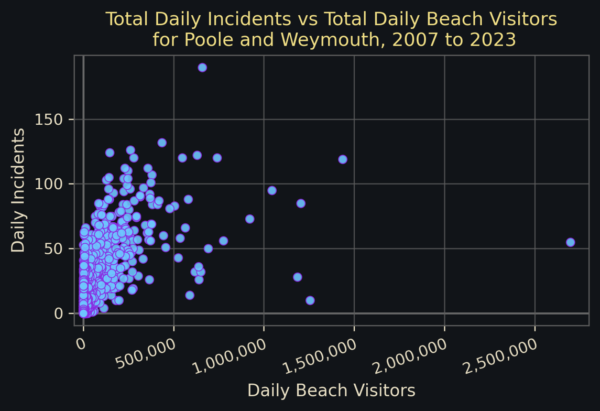
Water safety is just as important. Our initial exploration shows that more people at the beach correlates with more incidents in the water (Figure 2). Research shows that this is an issue all across the UK, not just the coast. Choosing lifeguarded beaches, paying attention to signage and local advice, and wearing appropriate buoyancy aids when on water vessels are great starters. Understanding dangers such as cold-water shock (even if you are a great swimmer) can make a large difference, particularly in spring when the sea hasn’t had time to warm up and the temperature difference between the air and the water can be of 25°C. If danger strikes, knowing what to do in an emergency (like phoning 999, telling people in the water to stay calm and float on their back, and throwing rescue equipment to help them float until emergency services arrive) can save lives. A study on water safety shows that teenagers and young adults are especially affected, talking to your teenage children about this information could be beneficial. With these small preventative actions, we can all help reduce pressure on lifeguards and ambulance services, ensuring help reaches further. For great water safety details go to https://rnli.org/safety |
| |
|
Figure 2. Total number of water incidents vs total beach visitors per day in RNLI-supported beaches in Dorset. Namely, from two lifeguard support centres in Dorset: Poole which supports RNLI lifeguarded beaches from Swanage to Highcliffe; and Weymouth which supports RNLI lifeguarded beaches in Weymouth and Lyme Regis. Data from 2007 to 2024. |
| |
|
So, make the most out of the longer warm season, but keep in mind that it comes with need for awareness in peak heat months. If we make sure we know our safety needs, check the latest forecast, pack basics like water and sun protectors, and respect the water, longer seasons can be pleasantly enjoyed |
| |
|
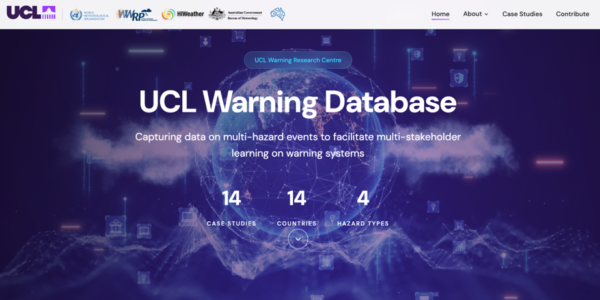
The University College London (UCL) Warning Database was launched on 4th March by the UCL Warning Research Centre (WRC), and is the world's first publicly accessible database that collects and shares data around specific hazards, threats, or disaster events, to investigate the warning processes involved.
The Database builds on the world’s first global warnings database developed by the HIWeather Project, part of the World Meteorological Organization (WMO) World Weather Research Programme (WWRP). The project devised a questionnaire to collect information relating to high impact weather warning case studies from around the globe. The aim was to facilitate scientists and practitioners to review, analyse and learn from previous experience through the lens of the warning value chain. Whilst this project ended in 2024, UCL WRC has worked in collaboration with the WMO to publish the database with open access. This involved designing an integrated database that enables both the smooth entry and visualisation of data.
The UCL Warnings Database collates examples from significant events to smaller more localised events to enable a rich source of data about the role of warnings in managing a crisis at different stages of the warning process. This enables the database to provide:
§ One-stop-shop on warning types, communication channels, and dissemination methods used
§ Case studies and cross-cutting analysis of warnings, from simple to complex, to understand effective practices
§ Exploration of how warnings work at different scales, from local to international
§ Data on decision-making processes across different scales
§ Maps and data on actors involved in the entire value chain warning system
§ Perspectives on how warnings were received by different stakeholders
§ Data on vulnerability conditions
This data will help support research to further enhance warnings of the future and address some of the key research and practitioner questions in the field. This database supports a number of initiatives including:
§ Target G of the UNDRR Sendai Framework to ‘Substantially increase the availability of and access to multi-hazard early warning systems and disaster risk information and assessments to the people by 2030’.
§ The UN led Early Warning for All Initiative
§ The World Meteorological Organization ‘Catalogue of Hazardous Events’
§ The UN Hazard Information Profiles
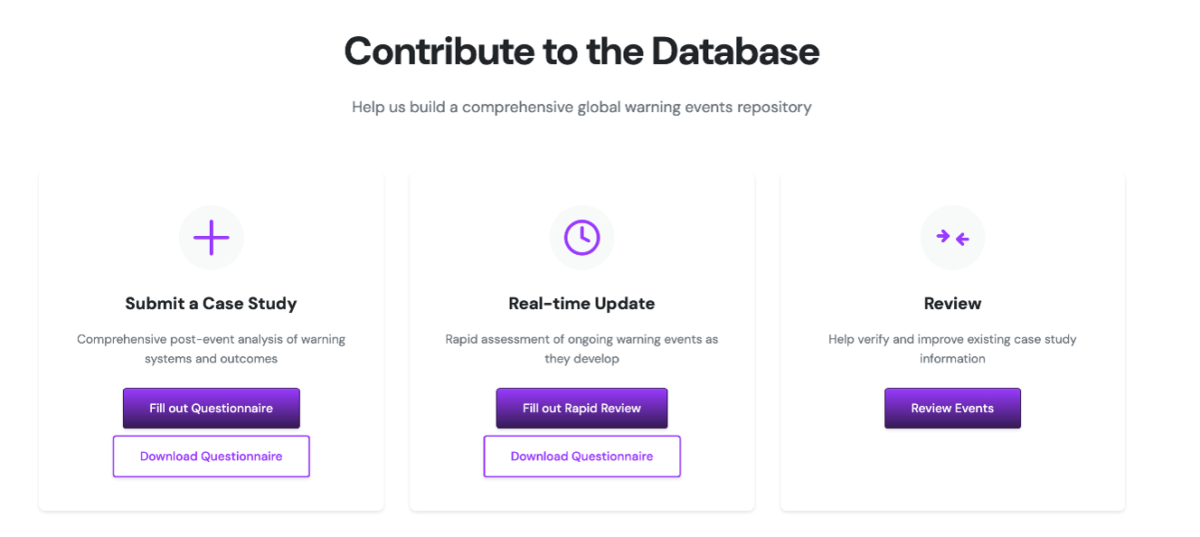
To date there are 14 Case Studies from 14 Countries, and 5 different Hazard Types and contributions can be made by: 1) submitting a case study by providing a comprehensive post-event analysis of warning systems and outcomes, 2) providing a real-time rapid assessment of ongoing warning events as they develop or 3) review entries to help verify and improve existing case study information. |
| |
|
A key novel component of the UCL Warning Database is to expand the database to include other hazards, including biological, environmental, and societal in line with the UNDRR Hazard Information Profiles, and to use AI to aid data collection, analysis, and synthesis.
The updated database enables multi-hazard warnings to be explored, and to capture multiple stakeholder perspectives during a single event. The aim is to link the database with other databases and catalogues e.g. DesInventar, EM-DAT, EW4All Dashboard etc.
The HuT project findings will be valuable contributions to the database, and we invite contributions about specific events that have occurred within the demonstration areas, and to pass along networks to encourage data entry to build up EU based case studies.
Useful Links:
You can access the database here: https://ucl-wrc.github.io/ucl-warning-database/
You can watch a recording of the launch event that provides further background on the database, how it works, and the various tools it offers: https://youtu.be/s74mKg9K1Z0
|
| |
|
Updates from Partner Projects
|
| |
|

PARATUS Project – Promoting disaster preparedness & resilience by co-developing stakeholder support tools for managing the systematic risk of compounding disasters
Download the third newsletter from the PARATUS Project and discover the latest updates, exciting opportunities and news from the projects of the Societal Resilience Cluster!
The PARATUS Consortium Meeting and Multi-hazard DRR Academy are fast approaching - interested in finding out more? Follow PARATUS on social media: Twitter, LinkedIn, YouTube

SYNERGIES Project – Innovating preparedness by leveraging SYNERGIES & enhancing results of DRM projects:
SYNERGIES is building on research from six previous projects (ENGAGE, RESILOC, LINKS, IMPACT, BUILDERS, Ready2Help). The project integrates findings, refines practices, and guides three real-life Preparedness Cases in La Réunion, Malta and Rotterdam. The ENGAGE project shared the testimonies of the citizens they had met over the years through a series of video pills that recount the citizens’ experiences and reactions to the seismic events that hit L’Aquila in 2009 and central Italy in 2016. The legacy collected by the ENGAGE project will be shared through SYNERGIES’ social media channels in the coming period to highlight the perspectives of the citizens which have been involved in these tragic events. Stay tuned, two new videos every week!
The Myriad project has two new reports describing recent events they’ve been involved in:
- Reducing Risks Together: Bridging Disaster Resilience and Climate Adaptation Strategies Workshop report at the European Civil Protection Forum 2024: https://zenodo.org/records/12744673
|
| |
|
Factsheets:
Publications:
- Neal, R., Robbins, J., Titley, H., Keates, S., Cox, D., Fenwick, K., Goodman, A., Evans, D., Freeborough, K., Dashwood C., Gammon, E. (2026) Warning Value Chain Assessments for Storms Eunice (2022) and Ciarán (2023): Insights and recommendations. Weather & Forecasting. https://doi.org/10.1175/WAF-D-25-0083.1
- Zhang S, Pecoraro G, Huang D, Peng J, Zhang B, Calvello M (2026) From hydro-meteorological thresholds towards an operational warning model for landslides at regional scale: A real-case application. Engineering Geology, 362:108542. https://doi.org/10.1016/j.enggeo.2026.108542
- Zhang S, Pecoraro G, Huang D, Peng J, Calvello M (2025) Integrating rainfall severity and soil saturation indices to define hydro-meteorological thresholds for landslides. J Hydrol, 654:132873. https://doi.org/10.1016/j.jhydrol.2025.132873
- Orozco-Messana, J., Orozco-Sanchez, F. J., & Calabuig-Moreno, R. (2026). Building Cooler Cities: Advanced Simulation as the Foundation for Climate-Resilient Modular Public Space Design. Applied Sciences (Switzerland), 16(4). https://doi.org/10.3390/app16041777
- Asurza, F.A., Abancó, C., Hürlimann, M., Medina V. (2026) Calibration scenarios for physically based rainfall-induced landslide modelling at regional scale. Application to Vall d’Aran (Central Pyrenees, Spain). Bull Eng Geol Environ 85, 27. https://doi.org/10.1007/s10064-025-04697-y
- Asurza, F.A., Hürlimann, M., Medina, V. (2026) Coupling hydrological, geotechnical and machine learning models to enhance landslide prediction for an early warning system: application to Upper Garonne River Basin, Pyrenees, Spain. Landslides. https://doi.org/10.1007/s10346-025-02685-7
- Fernandez-Garza, A., Gielen, E., Pulido-Velazquez, M., Avila-Velasquez, D., Rubio-Martin, A., & Macian-Sorribes, H. (2025). Potential impact of climate change on heatwaves at the urban scale: An evaluation in Valencia, Spain. Urban Climate, 64. https://doi.org/10.1016/j.uclim.2025.102681
- Avila-Velasquez, D. I., Macian-Sorribes, H., & Pulido-Velazquez, M. (2025). How Good Are Drought Forecasts? Skill of multi-model Seasonal Forecast of Meteorological Droughts in a semi-arid Mediterranean Basin. Earth Systems and Environment. https://doi.org/10.1007/s41748-025-00965-9
New Project Deliverables:
All project deliverables are made available via the Project Deliverables webpage and on The HuT ZENODO community |
| |
|
Upcoming Events:
Capturing the NEXUS: A global photo contest connecting art, science & society - FESTAS 2026 https://festas2026.github.io/nexus/index.html
|
| |
Views and opinions expressed are, however, those of the author(s) only and do not necessarily reflect those of the European Union or REA. Neither the European Union nor the granting authority can be held responsible for them.
|
| |
|