Vilnius University scientists invited to discuss the capital’s adaptation for extreme rainstorms
Project Update / April 2, 2025
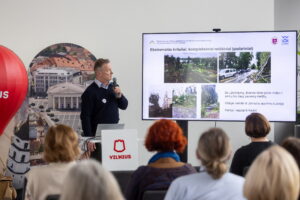
In March 2025, the Vilnius City Municipality hosted a climate forum “Vilnius’ adaptation to climate change risks: extreme rainstorms and urban flooding”, initiated by Institute of Geosciences of Vilnius University. During the event specialists from various fields together with residents collaboratively elaborated the set of adaptation measures which could reduce the risk of natural disasters in Vilnius.
The event was part of our project, and experts from Lithuania and Spain gave presentations, and later national and municipal decision-makers, planners, water management and cultural heritage specialists, representatives of local communities and school students discussed with scientists searching for possible solutions to reduce the risk of pluvial flooding in Vilnius.
Assoc. Prof. Dr. Gintautas Stankūnavičius (Vilnius University) presented the goals and activities of the “The HuT” project and introduced the changes in precipitation intensity in Vilnius. We learned about the flood caused by extreme rainfall in Valencia, Spain on October 29, 2024 from Dr. Adria Rubio-Martin (Polytechnic University of Valencia, Spain).
The activities of the city of Vilnius related to adaptation to a changing climate were presented by climate change expert Dr. Dovilė Karlonienė (“Neutralus klimatui Vilnius”), Ieva Stanienė, Head of Sustainability and Supervision Group of UAB Grinda, and Rokas Vanagas, environmental expert of this company. Dr. Viktorija Mačiulytė (Lithuanian Hydro meteorological Service) read a report prepared jointly with Dr. G. Stankūnavičius and Dr. G. Godiene (Vilnius University) on the cases of flooding in Vilnius city in 2013–2024 mentioned in public media reports, and the inconvenience and damage caused to Vilnius residents. Kristina Viršilaitė, Researcher at the European and Mediterranean Centre for Climate Change (CMCC, Italy), demonstrated the hydraulic analysis of the impact of precipitation on the drainage system carried out in the pilot area of the Vilnius Historical Centre.
The inclusive discussions aimed to find ways to prepare for and overcome the flooding problems caused by extreme rainfall in Vilnius. In assessing possible climate change changes, it was examined what solutions to reduce the risk of these natural disasters are possible and acceptable, it was discussed what situations we need to avoid, to which and how – to adapt, and also – how, taking into account the expected risks, the city’s surface wastewater infrastructure, urban planning and design practices should be changed, the city’s natural framework should be implemented, nature-based solutions should be applied, etc.
In six groups, 40 people refined the list of measures to solve the Vilnius city’s flooding problems, which mentioned such important aspects as the protection of natural areas, surfaces in the city, greening of territories; development of a network of automatic meteorological stations creating new spots of data collection; the implementation of principle – to catch and keep water where it falls, not transmitting it; the enlargement of permeable surfaces; the renovation of the surface wastewater system; the installation of rain water storage basins; the separation of surface and domestic wastewater systems; education’ changes in legislation, etc.
In order to develop climate proved sewage system design recommendations, it is important to know the opinions of various stakeholders, to clarify the social limits of acceptability, the possible tolerance for floods caused by heavy rains and urban flooding in Vilnius. Due to this goal, the groups discussed how often and to what extent it is acceptable of flooding of streets, courtyards, the UNESCO protected Historical centre of Vilnius, public spaces and other important urban areas with varying traffic intensity.
At the end of event, the participants concluded that it was interesting and important to discuss these very complex problems of rainwater management with people with different backgrounds, experience and expertise, that broadened the perspectives. Densely built cities will have to adapt to climate change, change policies, legislation, allocate additional funding, apply scientifically based planning solutions and systematically implement plans. It is no less necessary for different fields, science and the residents to combine their efforts, cooperate more, exchange knowledge and data.
Latest updates
All news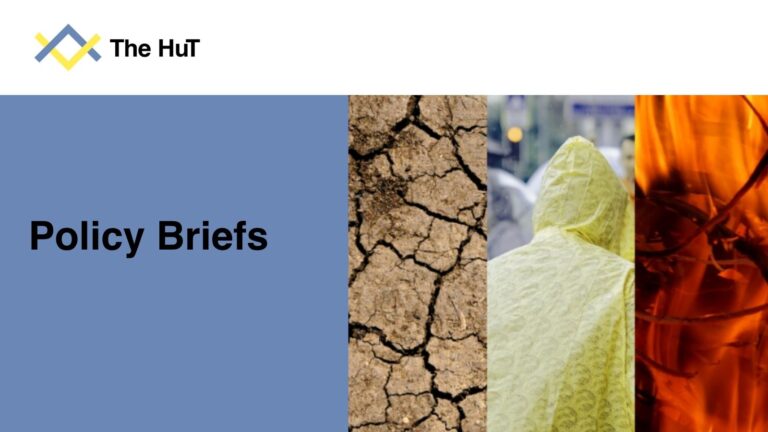 Press releases / July 30, 2026
Strengthening disaster warnings and scaling up nature-based solutions in Europe: The Hut Policy Briefs
Drawing on research from Iceland, Italy, Switzerland, the UK, Spain, Germany and Lithuania, the briefs show how public engagement and co-creation can make early warning systems more trusted and inclusive, and set out concrete policy options from technical manuals to cross-sectoral coordination units for moving nature-based solutions from isolated pilots to systematic, large-scale practice.
 Project Update / April 14, 2026
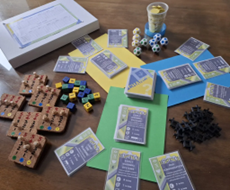
New HuT Factsheet Out Now: Using Serious Games to Promote Risk Awareness
How can we make complex topics like geo-hydrological risk easier to understand, especially for younger audiences?
 News release / March 24, 2026
Capturing the NEXUS: A Global Photo Contest Connecting Art, Science and Society
How can photography capture the connection between art, science, and society?FESTAS 2026 invites photographers worldwide to explore this question through its newly launched International Photo Contest, organised in conjunction with our final event! As part of the Festival of Art & Science (FESTAS…